Ethical Implications of AI in Healthcare

Imagine a future where AI helps doctors catch diseases before symptoms appear, tailors treatment plans to unique biology, reduces wait times, and automates repetitive tasks, freeing healthcare professionals' time to focus on more complex cases. While this vision is thrilling, it raises ethical questions that must be addressed. This blog delves into some critical ethical considerations surrounding AI in healthcare, focusing on four key areas: bias, accountability, data ownership and privacy, and economic impact. Let’s start with bias.

How can AI be biased?
AI algorithms are trained on existing data, which can, unfortunately, reflect societal biases. The algorithms can then perpetuate these biases, leading to discriminatory practices in areas like patient diagnosis, treatment recommendations, and access to care. Studies have shown potential biases based on race, ethnicity, socioeconomic status, and even zip code. Addressing these concerns through diverse data sets, regular algorithm audits, and human oversight are crucial to ensure the responsible use of AI in healthcare.
How do we mitigate the bias with AI?
While AI in healthcare can perpetuate existing biases by implementing best practices, AI can be a powerful tool for identifying and mitigating them. By analysing vast datasets, AI can uncover potential discrepancies and flag areas where historical biases might influence outcomes. This awareness allows the healthcare industry to take proactive steps towards fairness and equity. One approach involves ensuring diverse data sets accurately reflect the population, including various demographics and socioeconomic backgrounds. Additionally, regular audits and algorithm monitoring are crucial to identify and correct any bias emerging as technology evolves. Finally, involving human experts in decision-making remains essential, ensuring the responsible application of AI and safeguarding against bias creeping into healthcare practices.
How does Laser AI work with bias?
As an existing AI tool used in the healthcare industry, Laser AI avoids the bias through:
- Human Oversight: Laser AI does not take any decision or judgment call away from the team or expert. The AI model might make specific suggestions based on decisions being made. However, complete control is still left up to the team to accept or deny these suggestions.
- Regular audits: As technology and the industry evolve, so do algorithms and Laser AI.
The next point is accountability.
Before AI, accountability was, subjectively, a straightforward topic. There were clear boundaries regarding who was accountable for making decisions and implementing practices. Enter AI that influences these decisions, and the waters have muddied somewhat. Who is responsible for decisions influenced by AI? This question and concept fit into a more extensive misunderstanding of AI: that it replaces decisions, teams, and autonomy.
It is crucial to navigate the complexity of AI in healthcare to identify who is responsible. Is it the user of AI? Is the organisation offering the AI tool accountable? Or is it the organisation that pays to use the AI tool? With the multitude of AI services available, it is vital to be aware of the terms of the agreement.
In the case of Laser AI, the tool leverages machine learning as a supportive tool that aids in analysing references. The tool helps streamline the decision-making process but does not replace them. This approach allows users to maintain complete control, ensuring continued accountability for outcomes.
Data Ownership, Protection & Privacy

As with accountability, when data is involved, it is vital to understand where and how data policies are implemented. Every tool, whether AI or not, is governed by differing sets of rules & regulations based on their country and company policies. It is essential to be familiar with the proper regulations to ensure compliance, particularly in healthcare.
Since the difference can vary significantly between companies and countries, we can only speak on our path.
In terms of data ownership, Laser AI is straightforward. No content is being created in the process as with generative AI. A team uploads existing documents to the tool, and Laser AI helps to analyse them to streamline the screening and review process.
Protecting this data is crucial, and ensuring that the tool a team uses has robust security measures, user control over data collection, and compliance with regulations like HIPAA and GDPR are essential.
Major organisations like the WHO advocate for ethical frameworks that emphasise responsible data practices and user control. While AI offers benefits, careful implementation of privacy-preserving techniques is critical. Unlike ChatGPT, which processes vast amounts of online information raising privacy concerns, Laser AI focuses solely on documents provided by a team that does not access personal health data directly. Laser AI takes data security very seriously, and with ISO27001, SOC2, and FEDRAMP certifications, organisations can be sure that their data is secure with us.
Job Displacement & Economic Impact
The ethical considerations of AI on the economy and over jobs is a sensitive topic that needs its moment in the spotlight. With AI's ability to automate and streamline repetitive tasks, the need for human input will grow smaller. However, freeing up this time to dedicate to specific and arguably more critical processes is also beneficial. In this particular example, Laser AI streamlined the screening process and saved 53% of the teams' time to do this, allowing this team to devote more time toward decision-making and more critical tasks.
There are advantages, disadvantages, benefits, and challenges to implementing AI in healthcare. These discussions are constantly ongoing, and it's not always clear which direction it might take.
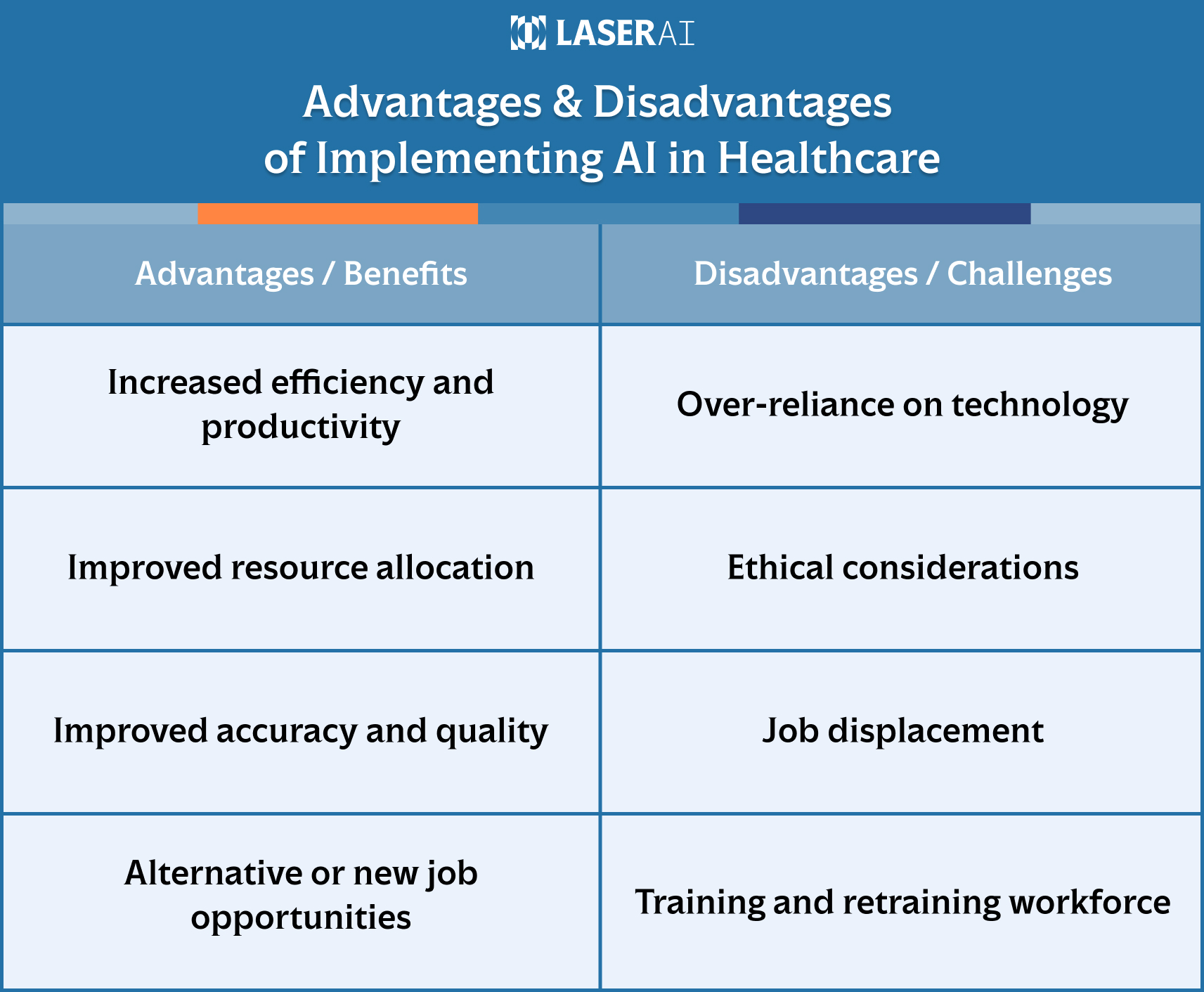
Overall, AI's economic impact in healthcare is complex and multifaceted. While potential advantages exist, careful consideration of ethical implications is crucial.
